(EN)
(EN) 


 Canada - EN
What to Do After a Car Accident: A Guide



On this page
- Step 1: Ensure everyone is safe
- Step 2: Call the police (if required)
- Step 3: Exchange information with other driver(s)
- Step 4: Document details of the accident
- Step 5: Seek medical attention
- Step 6: Contact your insurance company
- What happens after I report a car accident to my insurer?
- The bottom line
- Get Your Free Car Insurance Quote
Whether you spin out on black ice, are rear-ended at a red light or get sideswiped in a parking lot, a car accident can happen in an instant. And they’re more common than many drivers realize: there were close to 90,000 personal injuries and over 115,000 victims injured as a result of collisions in 2023, according to the National Collision Database. Some experts estimate that the average driver will be involved in up to four accidents over their lifetime and file a collision claim roughly once every 18 years.
While you can minimize your risk by avoiding distraction, speeding and impaired driving, you can’t predict the road ahead — or the actions of others. What you can control is how prepared you are when something goes wrong.
Knowing what to do after a collision can help protect your safety, support your car insurance claim, and prevent costly mistakes. Whether it’s a minor fender bender or a more serious crash, here’s how to stay safe and handle the aftermath with confidence.
Key takeaways
-
After an accident, keeping calm and acting quickly can help protect your safety, support your insurance claim, and prevent costly mistakes.
-
Check yourself, your passengers, and others involved for injuries, and move to a safe location if possible.
-
Contact the police immediately if anyone has been hurt, killed, or if you suspect criminal activity. After, report the collision to your nearest reporting centre.
-
Exchange contact, vehicle, and insurance information with the other driver(s), but avoid speculating on fault or apologizing.
-
Document the scene carefully with photographs, notes, witness information, and details about the road conditions, traffic, and weather.
-
Get medical attention as soon as possible, even if you feel fine, since some injuries may not appear right away.
-
Report the accident to your insurance company as soon as possible, preferably within 24 to 48 hours.
Step 1: Ensure everyone is safe
A collision can leave you feeling shaken, anxious, or overwhelmed. Take a deep breath and steady yourself — panic just makes it harder to think clearly. Then, focus on safety first:
-
Check yourself and your passengers for injuries: Adrenaline can temporarily mask pain, so don’t assume everyone is fine right off the bat. If you’re injured, stay where you are and wait for help.
-
Turn on your hazard lights: This warns approaching drivers to slow down and navigate safely around the scene.
-
Move to a safe spot (if possible): In a minor accident, move your vehicle to the shoulder or another safe area, especially on busy or high-speed roads.
-
Check on others involved: This includes other drivers, passengers, pedestrians, or cyclists. Do not move anyone who appears seriously injured, disoriented, or unconscious, as this could potentially worsen a head, neck, or spinal injury.
-
Call 911 if necessary: Contact emergency services if there are injuries, major vehicle damage, criminal activity, or airbag deployment. Wait for first responders to assess the situation before leaving the scene.
Step 2: Call the police (if required)
Call 911 immediately if any of the following apply:
-
Anyone is injured or there has been a fatality.
-
You suspect criminal activity, such as impaired or dangerous driving.
-
The other driver flees the scene (otherwise known as a “hit and run”) or fails to provide required information.
-
A pedestrian or cyclist has been injured.
-
The collision involves dangerous goods or creates a safety hazard.
-
There’s damage to private or public property, such as a guardrail, traffic light, or utility pole.
Provincial reporting thresholds
In many provinces, property-damage-only (PDOs) collisions that exceed a certain damage threshold must also be reported to police, even if no one is injured.*
Province/territory |
Minimum property damage to immediately report to police |
|---|---|
|
Alberta |
More than $5,000 in combined vehicle and property damage. |
|
British Columbia |
More than $10,000 in property damage. |
|
New Brunswick |
More than $1,000 in property damage. |
|
Newfoundland & Labrador |
More than $2,000 in property damage. |
|
Northwest Territories |
More than $2,000 in property damage. |
|
Nova Scotia |
More than $2,000 in property damage. |
|
Ontario |
More than $5,000 in combined vehicle and property damage. |
|
Prince Edward Island |
More than $2,000 in property damage. |
*Current as of May 2026
A police report can be useful if you need to file an insurance claim or take legal action later, as it provides an independent assessment of what happened.
Report the accident to a collision centre
For minor car accidents without injuries or signs of criminal activity, police may direct you to file a report at a Collision Reporting Centre (CRC) instead of waiting for an officer at the scene. These police-authorized reporting facilities operate in parts of Canada, including Ontario, Alberta, and Cape Breton in Nova Scotia.
Here’s what to expect:
-
Confirm whether a CRC report is required. If a police officer attends the scene, you may be given a report number to bring to the collision centre.
-
Go to the right location. Report to the nearest CRC in the jurisdiction where the accident took place, not the one closest to your home address.
-
Report within the required timeline. If your car is driveable, you may have a limited timeframe to report the accident. Depends on municipality, you should report the accident as soon as possible.
-
Bring the required documents. Take your driver’s licence, vehicle registration, proof of insurance, and any photos or notes from the scene.
-
Have the damage documented. Staff may photograph your vehicle and prepare an official collision report.
-
Follow up with your insurer. The report may be shared with police and insurers, but you should still contact your insurance company to confirm the next steps.
Some provinces may also allow drivers to begin the reporting process online before attending in person.
If you’re debating whether to report a collision, keep in mind that failing to do so could create problems later — especially if the other driver later claims injuries. Also, failing to report a reportable incident to the police or a CRC may lead to fines, demerit points, or a suspended licence.
Step 3: Exchange information with other driver(s)
Once everyone is safe, exchange personal information from the other driver(s). Under Canadian law, drivers must remain at the scene and provide their information to others involved in the collision. Failing to do so can lead to serious consequences, including fines, licence suspension, or criminal charges.
Collect the following details:
-
Personal details: Full name, address, phone number, and driver’s licence number.
-
Vehicle details: Licence plate number, vehicle make and model, vehicle identification number (VIN), and the registered owner’s name (if different from the driver).
-
Insurance details: Insurance company name and policy number.
Photograph the proof of insurance slip (or “pink slip”), vehicle ownership, driver’s licence, licence plate, and any visible damage for accurate record-keeping.
If the person refuses to share their information or leaves the scene, record as many details as possible — licence plate, vehicle description, and direction of travel — and call the police immediately.
Keep conversations brief and courteous. Do not apologize, admit fault, argue about what happened, or claim you are uninjured, as some symptoms may take hours or days to appear.
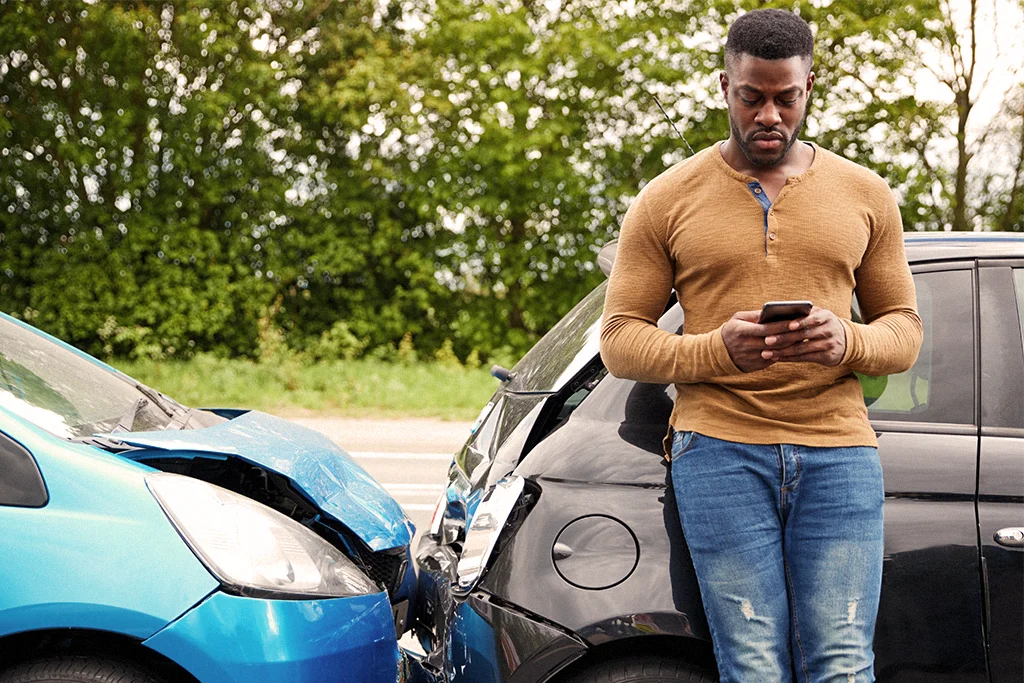
Step 4: Document details of the accident
Document the accident while the details are still fresh in your mind. Make sure to:
-
Photograph all vehicle damage, licence plates, visible injuries, the surrounding area, road conditions, and nearby traffic signals or signs.
-
Record the weather and visibility conditions, like ice, heavy rain, fog, flooding, and more. Even if the skies were clear and the road was dry, make a note of that.
-
Write a brief description of what you can remember about the accident, such as the time of day, your estimated speed, direction you were travelling, and position of other cars.
-
Sketch a diagram of the accident showing where each vehicle was positioned, along with relevant details, such as intersections or traffic lights.
-
Make a note of any concerning behaviour from the other driver, such as distracted driving, aggression, slurred speech, or signs of impairment.
-
Collect names and phone numbers from witnesses, especially anyone with dash cam footage or a clear view of the collision.
Related: What To Do In A Parking Lot Accident
Step 5: Seek medical attention
Even if you were evaluated by paramedics at the scene, get checked by a medical professional as soon as possible — ideally within the first 24 hours. Some injuries may take hours or even days to appear. Plus, establishing an official medical record of your condition is essential in the event you need to pursue legal action or make an insurance claim.
Depending on your symptoms, visit your family doctor, a walk-in clinic, urgent care, or an emergency room. Delayed symptoms after a collision can include:
-
Headaches or dizziness
-
Neck, shoulder, or back pain
-
Numbness or tingling
-
Fatigue or nausea
-
Swelling or reduced mobility
-
Changes in vision, hearing, concentration, memory, or mood
These symptoms may be linked to injuries such as whiplash, concussions, pinched nerves, soft tissue damage, or other underlying trauma.
When speaking with a healthcare provider, describe all symptoms in detail, specify when they began, and attend all follow-up appointments. Keep records of your diagnosis, treatment, prescriptions, and follow-up appointments, as medical documentation may be important for insurance or injury claims later.
Step 6: Contact your insurance company
Report the collision to your insurance company as soon as possible. Generally speaking, insurers expect accidents to be reported within 48 to 72 hours, although timelines vary by province. In Ontario, for example, drivers generally have up to seven days to report a collision to their insurer.
Overall, the sooner you report, the better. It helps preserve evidence, verify facts, and support your claim while the incident is still fresh. Delays could complicate the claims process or even affect coverage.
Typically, you’ll need to provide the following when making your report:
-
Your policy number
-
Make, model, year, VIN and licence plate of the vehicle
-
Name and licence of the person driving
-
Name and licence of the other driver(s), plus their insurance companies and policy numbers
-
Date, time and location of the incident
-
Number of passengers in the vehicle
-
Extent of any injuries
-
Extent of damage to the car
-
Your description of the accident, including weather, road conditions, traffic, etc.
-
Any photos or diagrams of the accident scene
-
The name and badge of any investigating officers and/or incident report number
In Quebec, drivers involved in collisions without injuries typically complete a joint accident report (know as le constat amiable) to help insurers process claims more efficiently.
When speaking with your insurer, stick with the facts and avoid speculating about fault. Claims adjusters will determine liability based on the available evidence.
Related: How To Avoid Insurance Fraud After A Car Accident
What happens after I report a car accident to my insurer?
When you report the collision, your insurer will explain the next steps, including vehicle repairs, rental car coverage, and the claims process.
Once the details of the accident have been reviewed, your insurer will typically:
-
Determine fault for the accident
-
Request a written declaration or formal “proof of loss” from you
-
Arrange for the vehicle damage to be professionally evaluated
-
Confirm what’s covered under your policy
-
Present the settlement terms
-
Obtain your approval before proceeding with repairs or payment
The bottom line
Even a minor car accident can be stressful and overwhelming. But knowing what to do — and acting quickly — can help protect your safety, support your insurance claim, and reduce unnecessary complications afterward. From documenting the scene to reporting the collision and seeking medical attention, each step plays an important role in protecting both your health and your financial interests.
Don’t wait until after an accident to find out whether you have the right coverage. Reviewing your policy with a licensed RBC Insurance advisor today can help ensure you’re properly protected. You can also get an online quote from RBC Insurance in minutes.
Get Your Free Car Insurance Quote
Take a few minutes to get a competitive auto insurance quote online